


An Introduction To Database Systems - Volume I
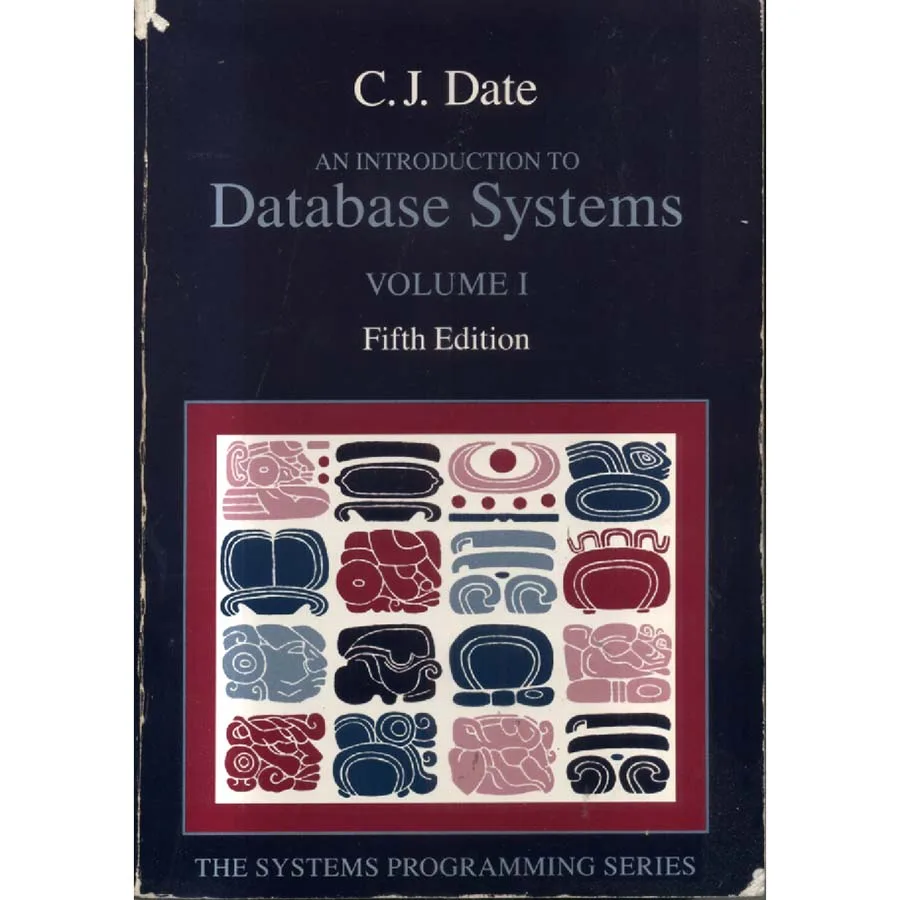
Publisher: Addison-Wesley
Format: Paperback
ISBN: 9780201528787
An Introduction to Database Systems – Volume I (1990) – C. J. Date
Addison-Wesley | ISBN: 9780201528787
Condition: Fair – Slightly Curved, Solid Binding, Fully Readable | Sold by Crappy Old Books
Databases. Those magnificent repositories of human knowledge into which civilisation has poured everything from banking transactions and medical records to railway timetables, customer complaints and the names of people who purchased a washing machine in 1978. Without them, modern society would collapse into administrative confusion, although anyone who has ever dealt with a government department might reasonably suggest that the process is already well underway.
Welcome to An Introduction to Database Systems – Volume I, C. J. Date’s celebrated textbook on the principles of database management, a work that has helped generations of computer scientists understand why information should be organised properly rather than scattered randomly across several thousand files named FINAL, FINAL2 and FINAL-REVISED.
C. J. Date is one of the most respected authorities on relational database theory, a subject whose intellectual foundations owe much to Edgar F. Codd and his revolutionary work on organising information into logical relationships.
The basic idea sounds wonderfully straightforward. Store data systematically, establish meaningful relationships between it and ensure that information can be retrieved accurately without requiring somebody to rummage through an electronic filing cabinet the size of Belgium.
Unfortunately, achieving this involves considerably more than creating a table and hoping for the best.
Date guides readers through the theoretical foundations of database systems, exploring relational models, data structures, integrity constraints, query languages, database design and the principles required to manage complex information reliably.
Particular attention is given to the importance of logical consistency and independence between the way data is represented and the physical machinery used to store it.
These are not merely academic concerns. A badly designed database can produce duplicate records, contradictory information and the spectacular administrative achievement of insisting that a customer simultaneously exists and does not exist.
The study of normalisation offers another opportunity for intellectual excitement, demonstrating how careful database design can prevent anomalies and reduce unnecessary duplication.
To the uninitiated, this may sound rather less thrilling than exploring the Amazon rainforest. To a database administrator confronting a million corrupted customer records, however, it represents civilisation’s last line of defence.
Published in 1990, this Addison-Wesley volume captures database technology during an important period in computing history, when relational database management systems were becoming increasingly central to commercial and scientific applications.
Although software platforms and technical standards have evolved, the fundamental principles of sound relational design remain enormously relevant.
Condition: Fair. This copy has a slightly curved appearance, giving it something of a well-travelled character. Importantly, the binding remains solid and the book is perfectly readable. It is an honest, serviceable reference copy rather than an immaculate display specimen.
Offered by Crappy Old Books, this 1990 edition is an appealing acquisition for programmers, database designers, computer science students and collectors of influential computing textbooks.
A substantial and intellectually rewarding examination of the systems that keep modern information organised, consistent and accessible.
Because computers can process billions of instructions per second, store extraordinary quantities of information and perform calculations beyond ordinary human comprehension.
Yet none of that prevents somebody from designing a database so badly that finding a customer’s address requires three programmers, two consultants and an emergency meeting.
As C. J. Date might reasonably argue, the answer is to get the relationships right.
Preferably before entering the first million records.
Keep browsing: See more IT books Other books by CJ Date
